
https://adage.com/creativity/work/north-face-top-imagens/2174261
Ihlen, Ø., & Fredriksson, M. (Eds.) (2018). Public relations and social theory: Key figures, concepts and developments (2nd ed.). New York, NY: Routledge.
https://adage.com/creativity/work/north-face-top-imagens/2174261
Ihlen, Ø., & Fredriksson, M. (Eds.) (2018). Public relations and social theory: Key figures, concepts and developments (2nd ed.). New York, NY: Routledge.
I enjoyed diving deeper into the Build-A-Bear Pay Your Age event crisis, especially since I remember a few of my friends sharing the promotion on Facebook about a week before it took place. I had never heard anything of it again, so it was eye-opening to see the massive amount of attention this company received following the event.
I will admit that I did find it a little difficult to connect theory to this real world situation; however, after taking a moment to really soak in the content and sociologists we have read about thus far in this course, I was able to get the ball rolling. It was intriguing to see that Robert Putnam’s cycle of social capital was so well displayed through the example I chose. I appreciated the opportunity to complete this project because I see and hear about communication crises all the time, but have never taken a step back to see how leadership at various companies approach crisis response and bounce back from these mishaps.
In terms of media production, I have had an interest in creating a podcast for a while now. I found it empowering to complete trial-and-error programs, until I finally decided on using iMovie (audio only). Here, I was able to play around with theme music and transition sounds to add some character to my podcast. I never figured out how to record my voice via iMovie, so I proceeded to record all voiceovers on my phone in the Voice Memo app, and AirDrop them to my laptop. Once I was done editing, exporting the mp3 and uploading it to SoundCloud was fairly simple.
I would definitely say that I pushed myself to achieve a better result beyond media productions I have completed in previous courses. For the first time, I listened to multiple podcasts including The Friend Zone and Therapy for Black Girls, to get inspiration on the format and layout of my podcast. Since I already love tuning into these podcasts for content, I thought “What better way to plan the template for my own?!”
Along with this, I realized the importance of scripting. In the past, I would write my scripts as if I were writing an academic research paper. For this podcast, although I stuck to the script, when I wrote it, I did my best to incorporate things I might say in conversation with my friends. Hopefully I was able to add a little personality to this one as opposed to others I’ve done.
Let me know what you think! I welcome all feedback.
TRIBES: WE NEED YOU TO LEAD US
By Seth Godin, 147 pages, $22
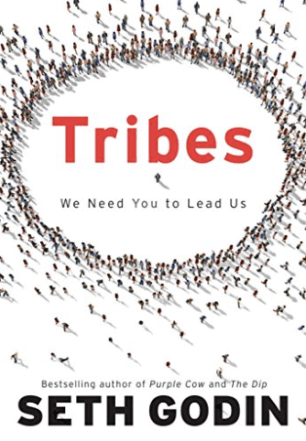
In Tribes, bestselling author Seth Godin essentially describes the importance of building and maintaining an intensely connected inner circle. Contrary to popular belief, and as seen on social media platforms such as Facebook and Instagram, we don’t need thousands of followers to make a real difference in the world. According to Godin, having a small, committed following is key. When a few individuals truly find meaning in your tribe’s message and purpose, they are more likely to genuinely promote positivity in regards to you and your cause. We are much more likely to give something/someone a shot if we hear good things from a trusted source, or sponsor.
This message resonated with me (and I believe it could with others as well) because the generation we live in today is obsessed with aesthetics and likes. It was refreshing to read about the importance of a real social network. We may have all gotten swept away in the ease of “connecting” with each other digitally, but it has really altered the way that we communicate. Godin reminds us that relationships matter and are still the bottom line for success. Social media can be a productive tool for tribes to emerge and prosper with proper leadership who is guiding utilization.
Moving into another theme of Tribes, leaders should “Lean in, back off, but don’t do nothing” (Godin, 2008, p. 59). Sounds complex, right? If you think back to the previous thought that the method with which leaders decide to guide their tribe has a massive effect on the impact of a mission. Leaders should certainly be passionate about their own message, and lean into that; however, it is equally important to be able to stand back and let your tribe communicate their ideas. Innovators can be found within tribes regardless of the fact that they were not the individual responsible for the overarching function of the tribe. Give others a chance to shine!
Some may be disappointed to find that this book is not necessarily a step-by-step for “How to Be a Great Leader,” but more of a broad description of what happens when leadership goes right. There are many examples of successful individuals whom we may have never considered leaders according to the status quo, including a violinist, a writer, an animal rights activist, and even more. Godin stresses that there is no blueprint to being a successful leader; if that were the case, everyone would be doing it.
An overall, but subtle key takeaway from Tribes is that rules were meant to be broken. It was intriguing to read about leaders who were not the status quo that we usually have in mind when we think of innovators. For instance, the example that stood out to me the most was about the creator of a sandwich with which we are all very familiar:
In 1967, just outside of Pittsburgh, a third-tier McDonald’s franchisee named Jim Delligatti broke the rules and invented a new sandwich. Within a year, the Big Mac was on the menu of McDonald’s restaurants around the world. (They even service a meatless version in India.)
(Godin, 2008, p. 74)
I enjoyed this read because of the wide array of life instances Godin’s messages could apply to. Sure, we may immediately and instinctively relate something like this to our 9-5 work lives (which I caught myself doing numerous times). We should definitely adopt this way of thinking in the workplace and not be sheepwalkers, accepting things as they are. Godin (2008) thinks to himself, “Isn’t it sad that we have a job where we spend two weeks avoiding the stuff we have to do fifty weeks a year” (p. 100)? In the same token, we must not take life outside of work as it is either, so let’s get to work!
*****
Godin, S. (2008). Tribes: We need you to lead us. New York: Portfolio.
Harris, C. (2018). How to find the person who can help you get ahead at work [TED Talk]. Retrieved from https://www.ted.com/talks/carla_harris_how_to_find_the_person_who_can_help_you_get_ahead_at_work?language=en
 Tierra Thomas